A metal-poor atmosphere with a hot interior for a young sub-Neptune progenitor (JWST transmission spectrum of V1298 Tau b)
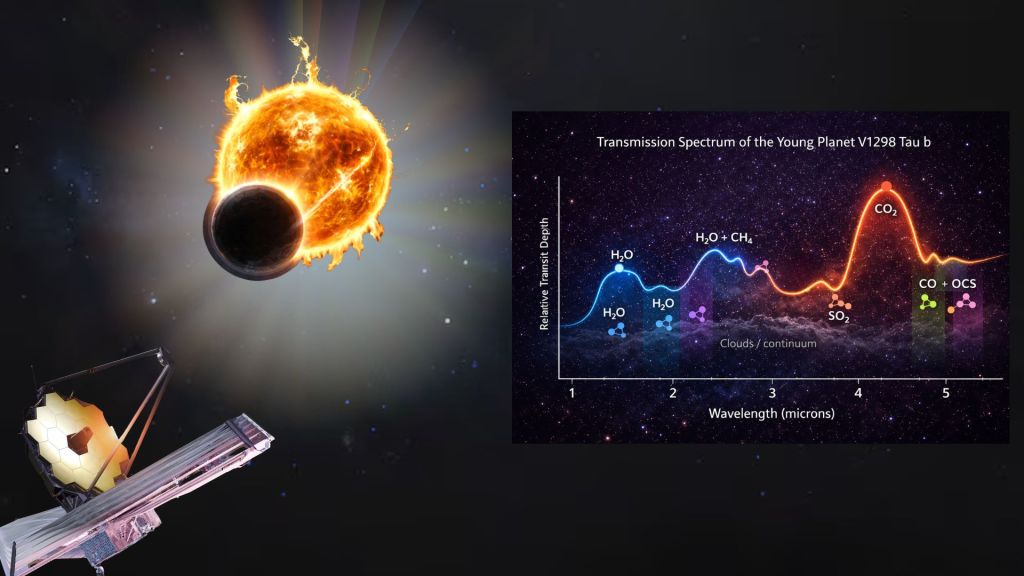
In this paper, we present JWST/NIRSpec transmission spectroscopy of the young planet V1298 Tau b, combining these observations with earlier Hubble data to investigate its atmospheric composition and structure in greater detail. Young sub-Neptunes are especially important targets because they allow us to probe atmospheric properties during the early stages of planetary evolution, when internal heat, mass loss, and chemical disequilibrium processes can significantly influence their observable characteristics.
From the transmission spectrum, we detect multiple molecular species including water, carbon dioxide, carbon monoxide, methane, sulfur dioxide, and OCS, confirming that the planet possesses a hydrogen–helium dominated atmosphere with a large scale height. By fitting atmospheric models to the data, we place strong constraints on the planet’s mass directly from spectroscopy, showing that it is substantially lower than earlier dynamical estimates and consistent with a young sub-Neptune progenitor. We also find that the atmosphere appears metal-poor compared with mature planets of similar mass, suggesting that atmospheric enrichment may occur later in planetary evolution.
A key result is the unexpectedly low methane abundance, which points to strong vertical mixing and a hotter-than-expected planetary interior. More broadly, this work demonstrates how JWST enables detailed chemical and structural characterization of young exoplanets, providing new insight into how sub-Neptunes form and evolve.
The metal-poor atmosphere of a potential sub-Neptune progenitor
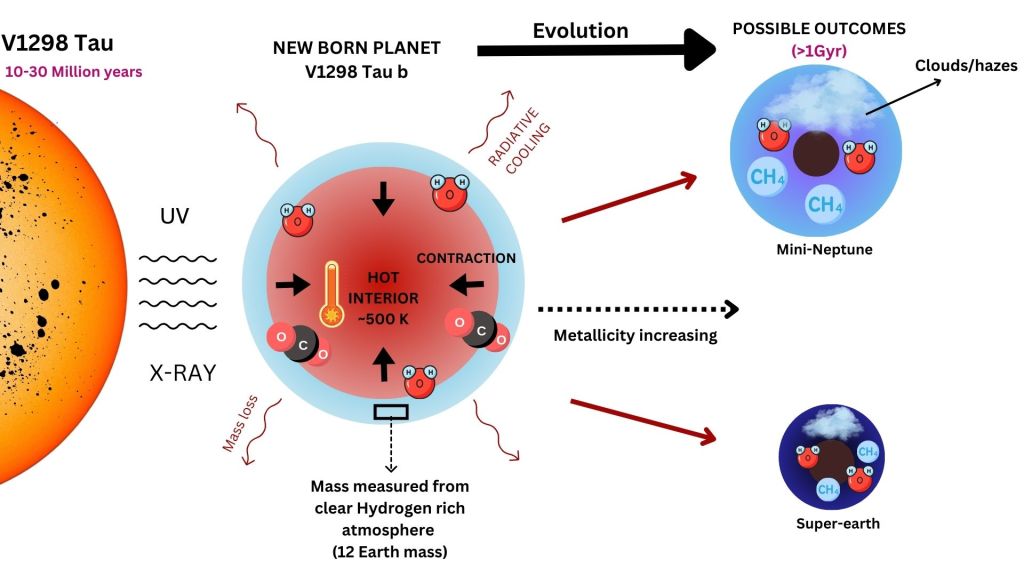
In this work, we study the atmosphere of the young transiting planet V1298 Tau b using near-infrared transmission spectroscopy with the Hubble Space Telescope. Young planetary systems are valuable laboratories for testing planet formation and early evolution models, but stellar activity makes reliable atmospheric and mass measurements challenging. By carefully modelling instrumental systematics and stellar contamination, we recover a robust transmission spectrum across the strong water absorption feature near 1.4 μm.
The large absorption amplitude implies an extended hydrogen-rich atmosphere with a very large scale height. Using this constraint, we place a stringent upper limit on the planet’s mass and show that it is more consistent with a low-density Neptune or sub-Neptune progenitor than a gas giant. Atmospheric retrievals reveal a surprisingly metal-poor envelope compared with mature planets of similar mass, challenging expectations from standard core-accretion theory. The non-detection of methane further suggests strong vertical mixing and a hotter-than-expected interior. Overall, this work identifies V1298 Tau b as a planet in transition and provides important observational constraints on how sub-Neptune atmospheres evolve.
First comparative exoplanetology within a transiting multi-planet system: Comparing the atmospheres of V1298 Tau b and c
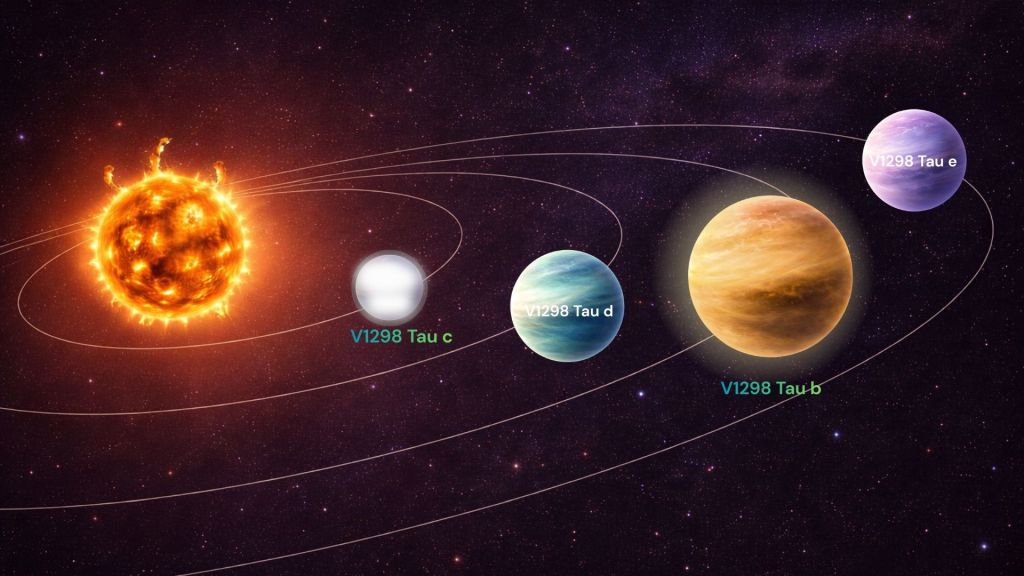
In this work, we carry out one of the first atmospheric comparisons between two transiting planets in the same young planetary system, V1298 Tau. Studying sibling planets orbiting the same star allows us to isolate how differences in irradiation and temperature influence atmospheric evolution while keeping stellar environment fixed. Using Hubble transmission spectroscopy, we analyze the atmospheres of V1298 Tau b and c to investigate these effects.
Our analysis shows that both planets are low-mass Neptune or sub-Neptune worlds with atmospheres that appear metal-poor relative to older planets of similar size, suggesting that atmospheric enrichment processes may still be ongoing. At the same time, we identify key contrasts between the two planets: haze formation can likely be ruled out for the cooler planet b, whereas the hotter and more strongly irradiated planet c may plausibly host hazes or aerosols. These results demonstrate how atmospheric properties can diverge even within the same system and highlight the power of comparative exoplanetology as a framework for understanding the diversity of Neptune-sized planets observed around mature stars.
Locating the GeV emission region in the jets of blazars from months time-scale multiwavelength outbursts
In this work, we investigate where high-energy gamma-ray emission originates within relativistic jets of blazars. Instead of relying only on spectral modelling, we develop a variability-based approach that uses coordinated optical and GeV observations to constrain the physical location of emission regions along the jet. By analyzing months-timescale multiwavelength outbursts across a sample of blazars, we identify paired flaring events that act as diagnostic probes of jet structure.
Using the relative energetics of optical and gamma-ray flares, we infer that a significant fraction of the observed GeV emission likely originates several parsecs downstream from the central black hole, beyond the broad-line region. This has important implications for particle acceleration mechanisms and for the radiation environments that shape high-energy emission in active galactic nuclei. More broadly, the study demonstrates how long-term time-domain observations can provide powerful constraints on jet geometry that are otherwise difficult to obtain, helping connect theoretical models of relativistic jets with modern multiwavelength monitoring data.
 saugatabarat.com