I study the atmospheres of planets outside our Solar System, with a particular interest in understanding how planets form and how they change during the early stages of their lives.
My route into this field began with a somewhat different problem. Before working on planets, I studied the jets of blazars, trying to determine where their high-energy emission was produced by looking at how their light changed across different wavelengths. It was, in retrospect, an early exercise in a problem that has stayed with me: much of what we want to know about distant objects cannot be observed directly. We have to reconstruct it from the light that reaches us.
During my PhD at the University of Amsterdam, I turned to planets, and particularly to young transiting planets. Most of the planets we know are old enough that their early histories have largely been erased. Young planets are different. Their atmospheres are still changing, their stars are unusually active, and many of the processes that shape a planet are happening on timescales that we can actually begin to observe.
Much of my PhD work centred on V1298 Tau, a young system with four planets. One of the first challenges was a fairly practical one: how do you measure the atmosphere of a planet when the star it is orbiting is itself changing dramatically? Spots, flares and other forms of stellar activity can produce signals that look a lot like the signals we are trying to measure from the planet. Developing ways to separate the two became an important part of my work, and led to the first atmospheric characterization of young transiting planets.
V1298 Tau offered something that a single planet cannot. Because several planets formed around the same star, we could compare them with one another. My work on V1298 Tau b and c became the first comparative atmospheric study within a transiting multi-planet system, allowing us to ask how planets that formed in the same place can nevertheless end up with very different atmospheres.
That work led naturally to another question: what can a planet’s atmosphere tell us about what is happening inside the planet? Recent JWST observations of V1298 Tau b revealed a much hotter interior than standard models of planetary formation and evolution would predict. My recent work has explored possible explanations for this unexpected heat, including the effects of clouds and processes deep inside the planet. In this sense, an atmosphere can tell us about much more than what is happening at the surface: it can give us clues about a planet’s interior and its history.
These questions have grown into KRONOS, a large JWST programme studying young sub-Neptune systems, where I am a co-investigator working on how these planets lose their atmospheres. Young planets can lose some of the gas they were born with as they grow older. For a long time, this was something we could understand mostly through models. With JWST, we can now begin to see it happening.
In our recent observations of V1298 Tau c, we detected hydrogen and helium escaping from the planet at the same time. The escaping gas forms a long tail extending far beyond the planet itself, and the observations suggest that V1298 Tau c is actively shedding the atmosphere it was born with. If this kind of mass loss continues as the planet evolves, it could eventually become a much smaller, rocky world.
But young planets are not the only way to investigate where planets come from.
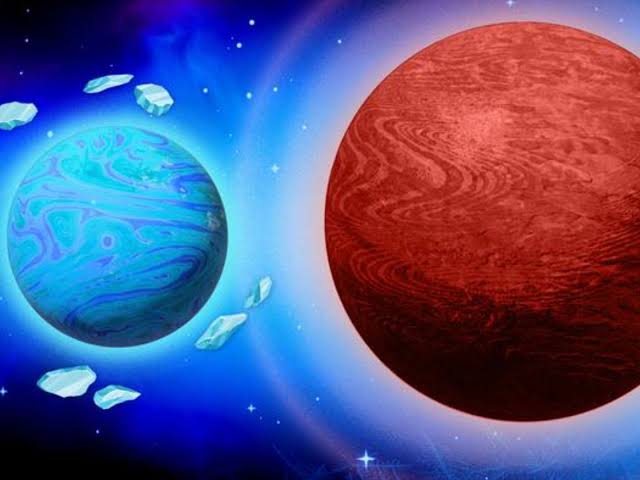
TOI-1130 is a very different kind of system: a mature sub-Neptune and a hot Jupiter orbiting the same star. Its unusual architecture offers another way to ask questions about planetary formation. I led the JWST study of the sub-Neptune’s atmosphere, finding an atmosphere with a relatively high mean molecular weight, and have also worked on observations of the system’s primordial spin–disk geometry. Together, these observations give us another way of thinking about how planets acquire the properties and architectures we see today.
These systems look very different, but they have led me toward the same broad set of questions: How do planets form? How do their atmospheres evolve? And how much can we learn about a planet’s early history from the atmosphere it has today?
I use observations from JWST and other space- and ground-based facilities, together with atmospheric modelling and retrievals, to try to answer those questions. What I find most interesting about exoplanet science is that we rarely get to study any one of these pieces in isolation. A planet’s atmosphere can tell us something about its composition; its interior can leave clues in the atmosphere; its orbit can tell us something about its history; and its neighbouring planets can provide the comparison that makes either observation meaningful.
The challenge is to put those pieces together into a picture of how a planet became the planet we see.